BYD e-Platform 3.0 Explained: What It Is and Which Models Use It

Quick answer: BYD e-Platform 3.0 is the engineering foundation under many of BYD’s pure-electric cars: a shared design that combines an 8-in-1 electric drive unit, a heat pump, a structural Blade Battery, and a low, long-wheelbase body. BYD launched it in September 2021 and followed with an upgraded version, e-Platform 3.0 Evo, in May 2024. It’s for pure EVs only, so plug-in hybrids use a different system. Neither version has been tied to a confirmed Canadian lineup, and most of the performance figures below are BYD’s own claims.
Questions about BYD technology or availability? Contact us → | Back to home
What a “Platform” Actually Is
When a carmaker talks about a platform, it means the shared hardware and layout that several models are built on: where the battery sits, how the motor and electronics are packaged, how the body is put together around them. Get one right and you can stretch it across a hatchback, a sedan, and an SUV without starting from scratch each time.
That’s what e-Platform 3.0 is for. It isn’t a single car or a single part. It’s a set of engineering decisions BYD made once and reuses, which is why you’ll see the name show up in the spec sheets and press material for very different vehicles.
Where It Came From
BYD launched e-Platform 3.0 in September 2021 and designed it exclusively for pure electric vehicles. That matters because a platform built only for batteries doesn’t have to share compromises with a petrol or hybrid layout. The floor can be flat, the wheelbase long, the front overhang short, and the centre of gravity low, because there’s no engine and gearbox to plan around.
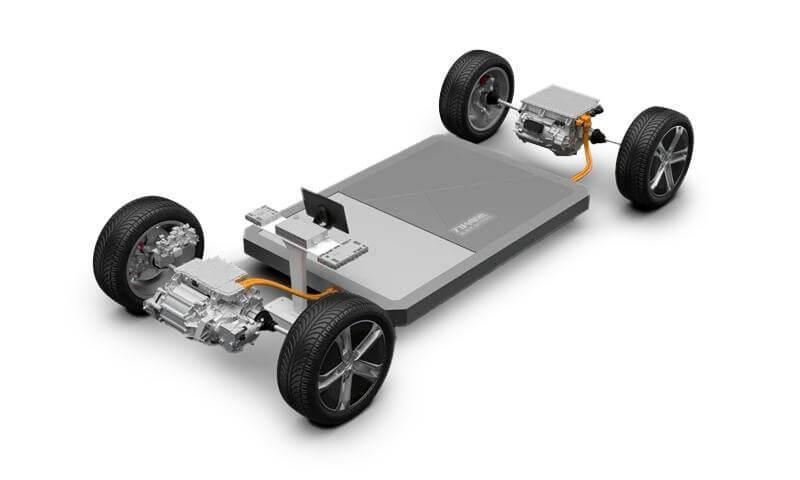
BYD’s own description of the Seal puts the platform alongside four other things: the Blade Battery, an 8-in-1 electric powertrain, a standard heat pump, and cell-to-body construction. BYD says the Seal was the first of its cars to get its in-house cell-to-body technology. Those four ideas are really the substance of the platform, so it’s worth taking them one at a time.
The 8-in-1 Powertrain
In a conventional EV, the parts that make the car go are separate boxes: a motor, a transmission, a motor controller, an onboard charger, a DC-DC converter, a power distribution unit, and the control and battery-management electronics. Each has its own housing, its own cooling, and its own wiring to the others.
BYD folded eight of those into one assembly: the vehicle control unit, battery management system, motor controller, power distribution unit, DC-DC converter, onboard charger, drive motor, and transmission. It calls this the world’s first mass-produced 8-in-1 electric powertrain, and BYD’s own e-Platform 3.0 explainer says the system reaches up to 89% efficiency. Both are BYD’s claims.
The logic is sound even if you discount the marketing. Fewer housings and fewer connections mean less weight and a smaller package, and a smaller package under the floor leaves more room for people and luggage. Fewer connectors can also mean fewer things to go wrong, although nobody has published long-term reliability data that proves it. The 89% figure describes the powertrain under ideal conditions. What you actually get on the road depends on speed, temperature, tires, and how you drive.
The Heat Pump and Winter
For Canadian buyers, this is the part to pay attention to. Heating a cabin is one of the biggest drains on an EV’s range in cold weather, and a heat pump is a more efficient way to do it than a simple resistive heater.
BYD says its system is standard on the Seal and works by reusing waste heat from the surroundings, the powertrain, the passenger compartment, and even the battery. It also describes a direct cooling-and-heating system for the battery pack that raises thermal efficiency by up to 20% in winter. Again, that’s BYD’s figure.
A realistic way to read it: a heat pump helps most in cool-to-cold weather, and its advantage narrows as temperatures fall well below freezing. Nothing in a platform spec repeals the winter range penalty. If you’re comparing EVs for a Calgary or Winnipeg winter, treat any manufacturer’s cold-weather claim as a best case, and look for independent winter range tests before you rely on it. We’ll add those to our model pages once Canadian data exists.
Cell-to-Body Construction
In most EVs, the battery is a sealed box bolted underneath the car. BYD’s cell-to-body approach, or CTB, makes the battery part of the body structure instead. On the Seal, BYD says the Blade Battery sits in the floor like the filling in a sandwich, with the cabin floor and the pack’s own top plate tying the left and right sides of the car together. BYD quotes a torsional rigidity of 40,500 N·m per degree for the Seal, which it presents as a sign of how stiff the body is.
The idea is stiffer structure, a lower floor, and better use of space, and it works well with the long, flat cells of the Blade Battery. Other manufacturers use a similar idea under the name cell-to-chassis. The trade-off is repair. A battery that’s part of the body is generally harder to separate from the car than a bolt-in pack, so crash repair and battery replacement tend to be more involved. That’s a bigger question in Canada than in China, because BYD doesn’t have an established service network here yet.
Body Shape and Aerodynamics
Because there’s no engine up front, BYD’s platform allows a shorter front overhang, a longer wheelbase, and a lower centre of gravity than a car adapted from a petrol design. BYD says the platform makes a drag coefficient as low as 0.21 possible. Treat that as a ceiling rather than a spec for every model, since individual cars come in higher. Low drag matters most at highway speed, where it’s effectively free range.
400V or 800V: Don’t Assume
System voltage is the number that decides how fast a car can accept power. Higher voltage lets the same power flow with less current, which allows faster charging and lighter cables. Most people never see this figure on a spec sheet, and it’s where “e-Platform 3.0” can mislead.
Most BYD models sold outside China run the original e-Platform 3.0 at around 400V. The 800V systems belong mainly to the newer Evo version. For example, published model references say the export Sealion 7 mostly uses the older 400V design, while the top European trim with the 91.3 kWh battery is built on Evo and runs 800V. Our Atto 3 page lists an 800V architecture on the 2026 Atto 3 Evo Premium. So if you see the platform name in a spec sheet, check the voltage and the DC charging speed separately. We list charging speed on every model page.
e-Platform 3.0 Evo
BYD launched e-Platform 3.0 Evo in May 2024, alongside the first car built on it, the Sealion 07 EV, which started at RMB 189,800 (about US$26,270 at launch) in China. CnEVPost’s launch report sums up the changes as higher integration, a stronger powertrain, and better charging performance. The headline changes:
- A 12-in-1 drive system in place of the 8-in-1, folding in more of the electronics.
- Motors that spin up to 23,000 rpm, which BYD says is the highest speed of any motor in production.
- A new wide-temperature heat pump, which BYD calls the first of its kind, aimed at using waste heat more efficiently in the cold.
- A cell-to-body safety architecture built into the structure.
| Feature | e-Platform 3.0 | e-Platform 3.0 Evo |
|---|---|---|
| Launched | September 2021 | May 2024 |
| Drive system integration | 8-in-1 | 12-in-1 |
| Motor speed | Not highlighted by BYD | Up to 23,000 rpm |
| Typical system voltage on export models | About 400V | 800V |
| Heat pump | High-efficiency heat pump | Wide-temperature heat pump, upgraded |
| First launch model | Earlier Ocean-series models (BYD cites the Seal for its in-house CTB) | Sealion 07 EV |
One caution: the table compares what BYD says about each version, and some of those claims overlap. We don’t have independent testing that separates “3.0” from “Evo” on the road, so don’t read the gap as a guaranteed difference in range or charging speed on a given car.
Which BYD Models Use It
BYD’s own materials confirm the platform on the Seal, and published model references list it on the export Sealion 7. In China, models on the Evo version include the Sealion 07 EV, the Seal 06 GT, and the Seal 06 EV.
For other models, including the Dolphin, BYD doesn’t always print the platform name on consumer spec sheets, and we’d rather note the platform on a model page only once BYD confirms it than guess. What we can say firmly is what it doesn’t cover: BYD designed e-Platform 3.0 for pure EVs only. Plug-in hybrids like the Shark 6 use BYD’s Super Hybrid technology instead, so they don’t have an e-Platform 3.0 in the first place.
What It Means for Canada
The platform doesn’t decide whether a BYD reaches Canada. That’s governed by permits and safety rules, which we cover in our posts on Canada’s Chinese EV quota and importing a BYD from China. BYD hasn’t published a Canadian lineup, so nobody can yet say which platform version the first Canadian models will use.
If you’re evaluating a BYD for Canadian conditions, the platform features that matter most are the heat pump, the charging voltage, and how the battery is serviced. Test claims on all three when independent Canadian data appears. And if you want to prepare something now, home charging is the part of EV ownership you can set up before any specific car arrives. See our guide to BYD home EV chargers.
How Much of This Is Marketing
A fair amount, and it’s worth saying so. Phrases like “world’s first mass-produced 8-in-1” and “highest-speed motor in production” are BYD’s own, and a platform spec tells you very little about reliability, repair cost, or service. Those are things you only learn over years and with a service network behind the car. What the platform does tell you is that BYD has built most of the core hardware itself and designed it to work together, which is a real engineering strength. Whether that translates into a better car in a Canadian winter is something the next couple of years of real-world data will settle.
Frequently Asked Questions
What is BYD e-Platform 3.0?
It’s BYD’s shared architecture for pure electric vehicles, launched in September 2021. It combines an 8-in-1 electric drive unit, a heat pump, a Blade Battery, and a body designed around a flat battery floor.
What does 8-in-1 mean?
BYD combined eight components into one assembly: the vehicle control unit, battery management system, motor controller, power distribution unit, DC-DC converter, onboard charger, drive motor, and transmission. The Evo version extends this to 12-in-1.
What’s the difference between e-Platform 3.0 and 3.0 Evo?
Evo, launched in May 2024, has a 12-in-1 drive system, motors that spin up to 23,000 rpm, an upgraded heat pump, and 800V charging architecture. The Sealion 07 EV was the first car built on it.
Which BYD models use e-Platform 3.0?
BYD confirms it on the Seal, and published references list it on the export Sealion 7. Evo models in China include the Sealion 07 EV, Seal 06 GT, and Seal 06 EV. Plug-in hybrids don’t use it.
Does e-Platform 3.0 help in winter?
The heat pump should, and BYD claims up to 20% better thermal efficiency in winter. But a heat pump helps less as temperatures fall well below freezing, and independent Canadian winter tests aren’t available yet.
Is BYD as good as Tesla?
On platform engineering the two are similarly ambitious, and BYD builds much of its own hardware. In Canada, Tesla’s lead is charging and service coverage, which a platform spec doesn’t measure. Which is better depends on what matters most to you.
How much would a BYD cost in Canada?
There’s no official Canadian pricing. BYD sets its own prices, and the quota’s 6.1% tariff makes lower prices possible than the old 100% surtax. Our model pages carry estimates and explain how we built each one.
Can I buy a BYD in Canada?
Not yet through BYD. In the latest reporting we’ve reviewed, BYD hadn’t opened Canadian orders. See our post on importing a BYD from China for why a private import isn’t a route.
What is the cheapest BYD electric car?
The Seagull, which starts at about 69,900 yuan in China, roughly US$10,000. It’s sold elsewhere as the Dolphin Mini, Dolphin Surf, and Atto 1, and it isn’t sold in Canada.
Why isn’t BYD sold in the USA?
The United States applies very high tariffs to Chinese-built EVs, which makes selling them there commercially impractical. Canada’s 2026 quota arrangement works differently.
Is Geely coming to Canada?
Trade reports name Geely among the Chinese brands working toward Canadian entry, but it hasn’t announced models or pricing.
